
Atoll
Ring-shaped coral island encircling a lagoon, found in warm tropical seas.

WEY · CC BY-SA 4.0
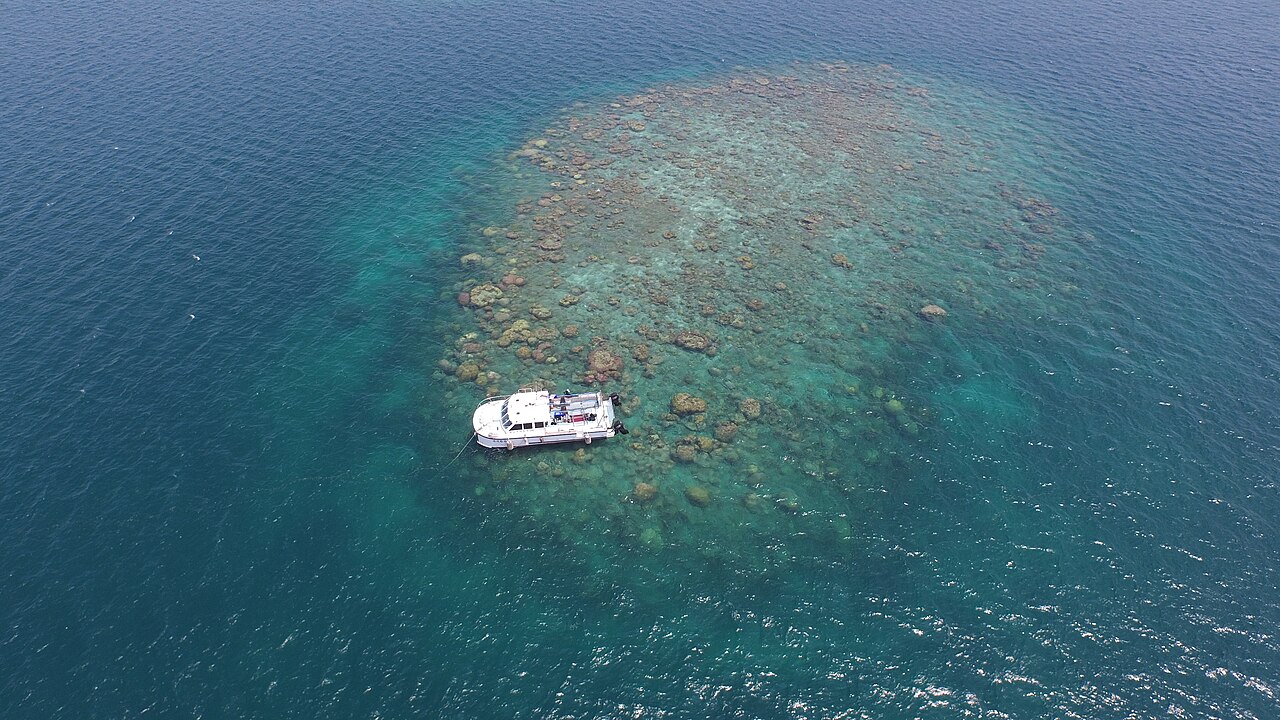
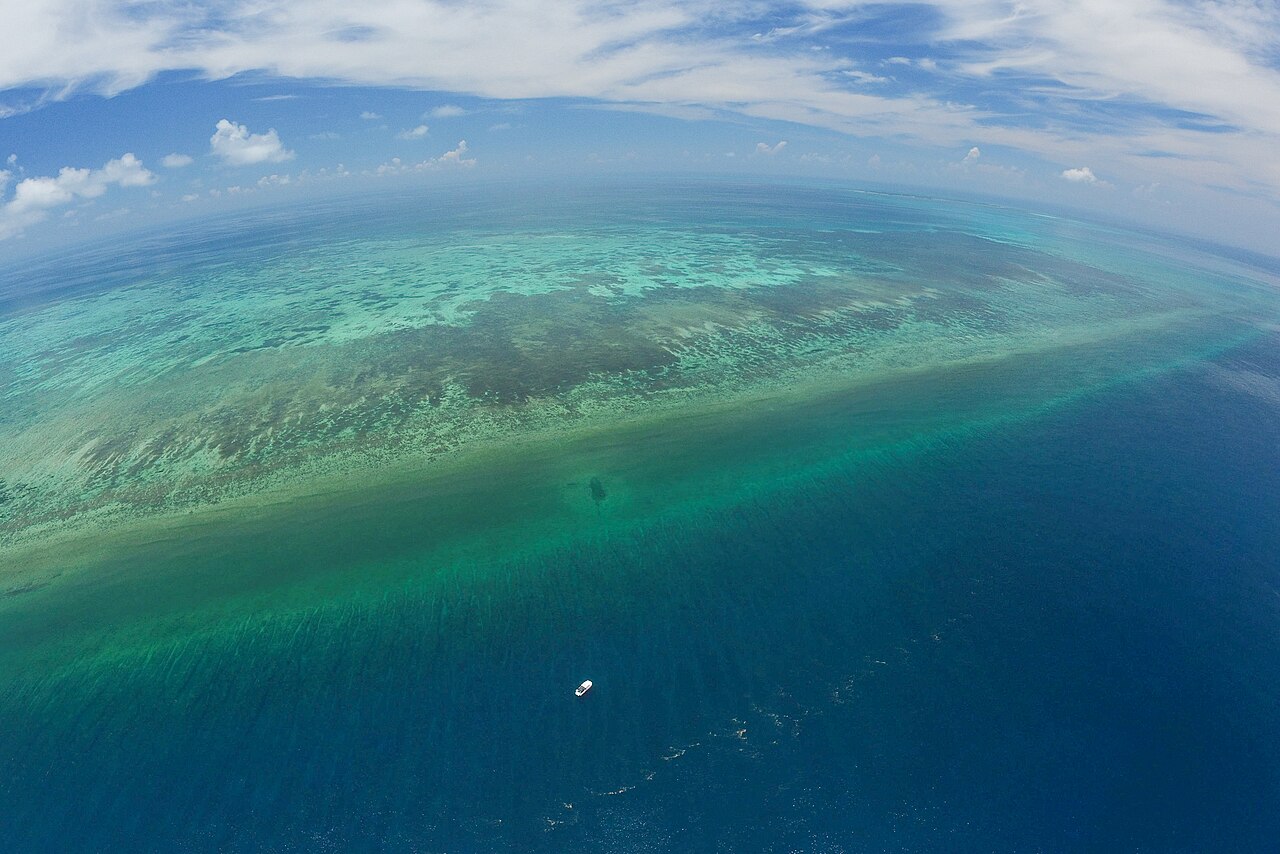
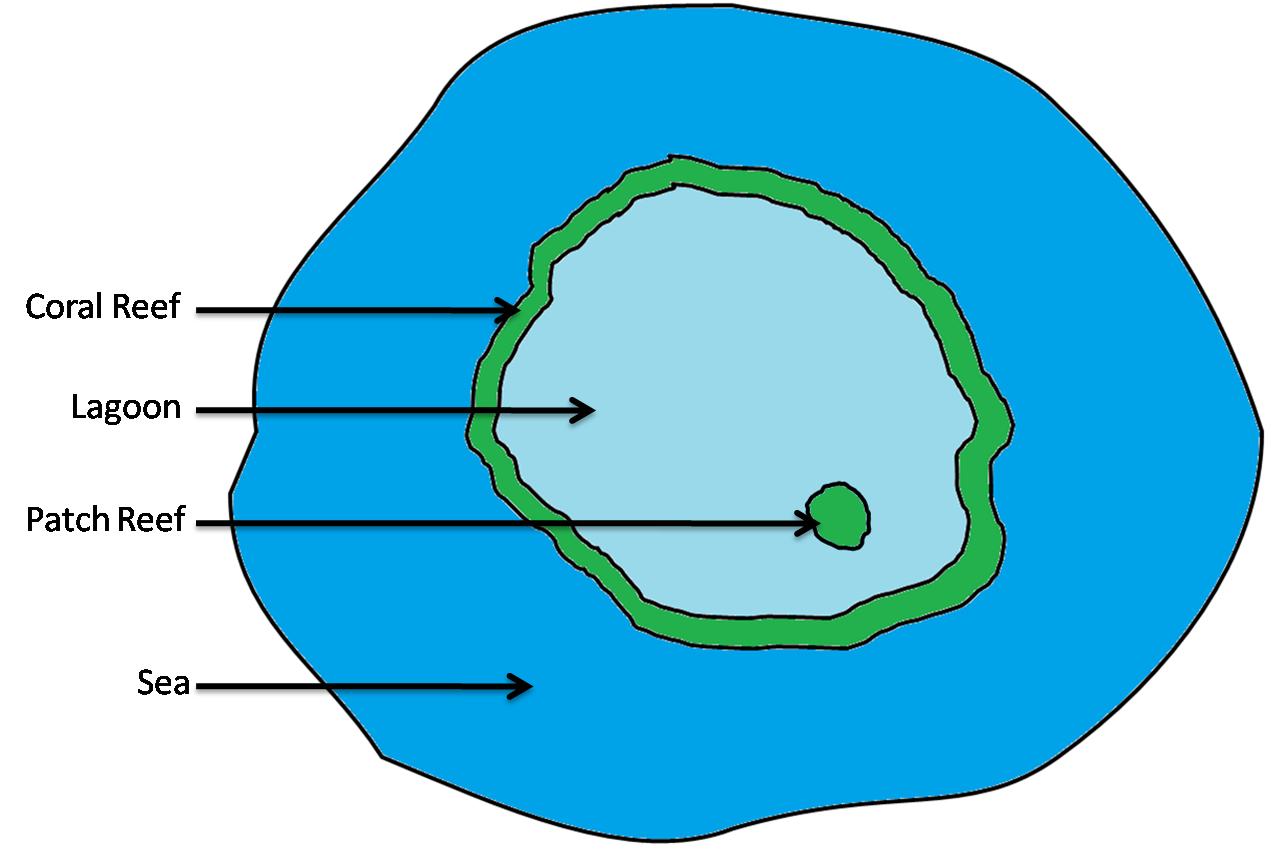
An atoll is a ring-shaped island, including a coral rim that encircles a lagoon. Atolls are located in warm tropical or subtropical parts of the oceans and seas where corals can develop.
- primary_ocean
- Pacific Ocean
- northernmost_atoll
- Kure Atoll at 28°25′ N
- southernmost_atolls
- Elizabeth Reef at 29°57′ S and Middleton Reef at 29°27′ S
Lore & Background
Two different, well-cited models explain atoll development: the subsidence model and the antecedent karst model. According to Charles Darwin's subsidence model, an atoll forms when a volcanic island with a fringing coral reef sinks over geologic time. The reef becomes a barrier reef, and eventually only the reef and small coral islets remain, with a lagoon replacing the former volcano. The lagoon is not the former volcanic crater. For the atoll to persist, coral growth must match relative sea level changes. The antecedent karst model proposes a different sequence: a flat-topped coral reef develops during subsidence of an oceanic island. When sea level drops, the flat surface is exposed to rainfall, forming limestone karst. Dissolution is slowest along the rim and fastest at the center, creating a saucer-shaped island with a raised rim. When sea level rises again, coral grows on the rim to form atoll islands, and the flooded center becomes the lagoon.
Reader's Guide
Atolls are significant as unique geological formations that illustrate the interplay between volcanic activity, coral growth, and sea-level change. They are found almost exclusively in warm tropical and subtropical waters, with the vast majority in the Pacific Ocean. Modern definitions describe atolls as annular reefs enclosing a lagoon. Atoll islands are low-lying, typically less than 5 meters in elevation. The northernmost atoll is Kure Atoll in the Northwestern Hawaiian Islands, and the southernmost are Elizabeth and Middleton Reefs in the Tasman Sea. Bermuda is sometimes called the 'northernmost atoll' but is considered a pseudo-atoll due to distinguishing characteristics. The two main formation models—subsidence and antecedent karst—remain subjects of scientific discussion, with recent research supporting the antecedent karst model for some modern atolls.
Did You Know?
- The northernmost atoll in the world is Kure Atoll at 28°25′ N.
- The largest atoll by land area is Kiritimati, a raised coral atoll.
Two Competing Theories of Atoll Formation
Scientists have long debated how these ring-shaped coral formations come into being, and two well-cited models dominate the discussion. Charles Darwin's subsidence model, first articulated in 1842 after observations made during his five-year voyage aboard HMS Beagle, proposes that a volcanic island gradually sinks beneath the ocean while a fringing coral reef around it keeps growing upward. As the island erodes and disappears, the reef detaches into a barrier reef, and eventually only the coral rim and small islets remain above water, with a lagoon occupying the space where the volcano once stood. Crucially, this lagoon is not the old volcanic crater. For the atoll to persist, coral growth must continuously match any relative sea-level change, whether from island subsidence or oceanic rise. The alternative antecedent karst model offers a different sequence: a flat-topped reef forms during subsidence, then a sea-level drop exposes it to rainfall, which carves a saucer-shaped limestone depression. When the sea returns, the raised rim becomes a rocky foundation for new coral, and the flooded basin becomes the lagoon.
Global Distribution and Geographic Extremes
Roughly four hundred and forty atolls dot the world's oceans, yet they cluster overwhelmingly in the Pacific, with dense groupings in the Caroline Islands, Marshall Islands, Tuamotu archipelago, Kiribati, Tokelau, Tuvalu, and the Coral Sea. The Indian Ocean contributes its own clusters—the Maldives, Lakshadweep, the Chagos Archipelago, and Seychelles' outer islands—while Indonesia scatters atolls through the Thousand Islands, Taka Bonerate, and Raja Ampat regions. The Atlantic is nearly barren, hosting just eight atolls off Nicaragua's coast in Colombia's San Andrés department. Because reef-building corals demand warm tropical or subtropical waters, atolls exist exclusively within those latitudinal bands. Kure Atoll in the Northwestern Hawaiian chain marks the northern limit at 28°25′ N, while Elizabeth Reef and Middleton Reef in the Tasman Sea define the southern boundary near 30° S. Aranuka in Kiribati sits closest to the Equator, its southern tip barely thirteen kilometres north. Bermuda, sometimes cited as the northernmost atoll at 32°18′ N, is actually a pseudo-atoll whose ring shape depends on Gulf Stream warming rather than natural coral development.
Scale, Structure, and Notable Examples
Despite their dramatic ring shape, atolls are deceptively small in terms of actual dry land. The islands that compose them are low-lying, rarely rising more than five metres above sea level, and the land area is a tiny fraction of the total footprint including lagoon and reef. When measured by total area, Lifou leads at 1,146 square kilometres, followed by Rennell Island at 660. By dry-land area, Kiritimati in Kiribati is often cited as the world's largest raised coral atoll, with estimates ranging from 321 to 575 square kilometres of land plus extensive lagoons. Aldabra holds the second-largest dry-land figure at 155 square kilometres. Huvadhu Atoll in the southern Maldives takes a different superlative: it comprises 255 individual islands, the most of any atoll. A related geological feature, the reef knoll, represents the elevated fossil remains of an ancient atoll preserved within a limestone landscape, appearing as a hill where a ring-shaped reef once floated at sea level.
The Word and Its Meaning
The term atoll traces back to the Dhivehi language of the Maldives, where atholhu, written in Thaana script, describes the ring-shaped island formations native to that archipelago. Dhivehi belongs to the Indo-Aryan branch and ultimately descends from a reconstructed Sanskrit compound, samtīrtha, meaning a flat connected ford or crossing between islands. The word crossed into European awareness in 1625 when the French traveller François Pyrard de Laval recorded it as atollon. Charles Darwin later adopted and formalised the term in his monograph The Structure and Distribution of Coral Reefs, defining it as a circular group of coral islets, synonymous with lagoon-island. Modern geomorphological definitions sharpen the picture: an atoll is an annular reef enclosing a lagoon in which no promontories exist other than the reef itself and small islets of reef detritus, or, in purely morphological terms, a ring-shaped ribbon reef surrounding a lagoon. These definitions exclude features like Bermuda, which mimics the shape but lacks the defining coral-reef character.
Gallery
Frequently Asked Questions
What is an atoll?
An atoll is a ring-shaped island formed by a coral rim that encircles a central lagoon. These structures develop in warm tropical or subtropical ocean waters where coral can grow.
What are the northernmost and southernmost atolls on Earth?
Kure Atoll at 28°25′ N is the most northerly atoll in the world. On the southern extreme, Elizabeth Reef at 29°57′ S and Middleton Reef at 29°27′ S mark the farthest south.
More in Geology And Landforms 1-17
Spotted an error? Know more?
This is a living reference — every entry is fact-audited, and reader corrections feed straight into our audit queue. Suggest an edit · See this site's audit record